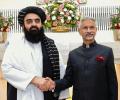
'Pakistan is uncomfortable with the Indian presence in Afghanistan. They want the Taliban to ensure that there is no Indian presence in Afghanistan.'

'Pakistan wanted India out of Afghanistan to which again the Taliban told Pakistan to take a walk.' 'Six months after they came back to power in 2021 India was back in Afghanistan at the request of the Taliban.' 'The Taliban realised that India has no agenda of its own in Afghanistan.'

Afghans have deep self-respect and are the last people to put up with humiliation. Is it any surprise that relations between Afghanistan and Pakistan have touched an all-time low and the two countries are now at war? asks M R Narayan Swamy.

'Islamabad feels it has no alternative, but to address the challenges from the Afghan-Taliban through an open war.'

'The unexpected turn of events and assertion of sovereignty by the Taliban has baffled the Pakistan security establishment.'
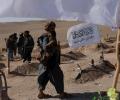
Afghanistan's Taliban forces targeted 'several points' in Pakistan on Saturday, Taliban said, days after Pakistani aircraft carried out aerial bombardments inside the country, as per Al Jazeera.
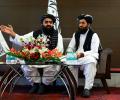
'During the 5-day visit, Amir Khan Muttaqi would have, conceivably, bumped into our powerful security agencies one way or another and some interaction would have ensued, which, in turn, can lead to future dealings.' 'Indeed, this will be the one crucial template of the Indo-Afghan relationship that Pakistan will be monitoring closely,' points Ambassador M K Bhadrakumar.
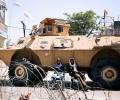
The activation of diplomatic channels is likely to yield better results than a simmering hostility, recommends Ajai Shukla.

The strange allegation by UAE officials is noted in a State Department cable, which reports the details of a meeting between officials of the US Treasury Department and those of UAE's State Security Department (SSD) and Dubai's General Department of State Security to discuss suspected Taliban-related financial activity in the UAE.

'It will remain hostile to Indian interests owing to its close proximity to China.'

The Taliban's main challenge comes on the financial and economic front and there Pakistan doesn't have the capacity to be of any meaningful help, observes Ambassador M K Bhadrakumar.
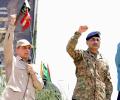
'We need to be very vigilant as we are passing through some fraught times.'

Once Mazar-i-Sharif falls, some isolate pockets of resistance may remain, which the Taliban would tackle through political work or coercion, asserts Ambassador M K Bhadrakumar.

"The most successful governments in Afghanistan tend to be those who have the biggest tents, which would include all communities and therefore leave all communities satisfied after a point and do not create massive resentments. Now, this is not a government which I would imagine would successfully govern Afghanistan," Dalrymple, the historian said.
Security expert B Raman writes on the alarming rise of Taliban in Pakistan.
The Pakistan government is supporting Islamist groups close to the Taliban in its attempt to suppress tribal insurgency in Balochistan, a leading international think tank has alleged. In its report Pakistan: The Forgotten Conflict in Balochistan, the International Crisis Group said that the Musharraf regime relies on divide-and-rule policies. It supports Pashtun Islamist parties like the JUI-F, a key patron of the Afghan Taliban, in a bid to counter secular Baloch forces.
Bashir Ahmed Bilour, a leader of Pashtun nationalist party, was among the eight killed during Taliban's suicide attack at Peshawar on Saturday.
The coherent strategy of the TTP has not been matched by an equally coherent one from Pakistan Chief of the Army Staff General Ashfaq Pervez Kayani. He has been struggling to counter the co-ordinated strategy of the TTP with a bits and pieces strategy depending on where the pressure from the TTP comes from.
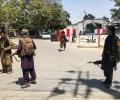
Despite dependence on the ISI for years of sustenance, Taliban leaders may harbour resentment over the ISI's excessive control, notes Rana Banerji, who headed the Pakistan desk at the Research and Analysis Wing.

India is apprehensive about the Taliban's return as it would mean loss of access to Baluch rebels and help to the restive tribals of Waziristan. This would be a setback to the Indian strategy of returning the compliments of death by a thousand cuts to Pakistan, notes Colonel Anil A Athale (retd).

The Taliban has its backers, notably Pakistan and China. Their purpose is to have a monstrous entity near India's northern borders to keep democratic, secular India off-guard, observes Amulya Ganguli.
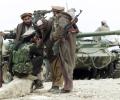
'Washington is well aware that the Haqqani group was responsible for terrorist attacks on the Indian diplomatic establishments in Afghanistan.' 'But today US self-interest dictates that Sirajuddin Haqqani's mainstreaming in Afghan political life and a potential elevation eventually to a leadership role at the national level is useful and necessary, since he can deliver peace,' notes Ambassador M K Bhadrakumar.
The opposition PML-N has opposed the Pakistan government's campaign against the Taliban, saying it is being waged to protect the "interests of the US".
Against the backdrop of the WikiLeaks disclosure about Pakistani spy agency Inter-Services-Intelligence's double-game in Afghanistan, former US Deputy Secretary of State Richard Armitage has said the Pakistani spy agency has a relationship with the Taliban.
The recent attacks in Pakistan's Punjab should be taken as warning shots of an impending battle which will further destabilise that country and the region.

Unless the Taliban goofs up in a big way, which seems highly unlikely, we are looking at a regime that will be around for quite a long while and present a level of governance that the puppets of the richest and most advanced countries failed to provide, predicts Ambassador M K Bhadrakumar.

Adnan Rashid, a Taliban fighter wanted for an attempt to assassinate former President Pervez Musharraf, wrote a letter to Malala, who was shot in the head in a militant attack last year.

'Whatever comes in the minds of the Pakistani generals and Pakistan military, they just go for it.' 'They do not care about the consequences for their country or the consequences to the people of Pakistan.'

As a proxy of Pakistan's ISI, Sirajuddin is believed to be behind several attacks directed against India, including the murderous attack on the Indian embassy in Kabul in 2008 and the 2013 attack close to the Indian consulate in Jalalabad.

Pervez Musharraf said that Pakistan tried to undermine the Afghan government led by ex-president Hamid Karzai for helping "India stab Pakistan in the back".
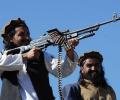
Amid accusations by Pakistan that America deliberately sabotaged peace talks by killing Taliban chief Hakimullah Mehsud, the Unites States on Sunday said the militant group has a "symbiotic relationship" with the Al Qaeda and provided "safe haven" to terrorists.
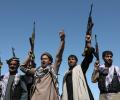
The 13th report of the Analytical Support and Sanctions Monitoring Team cites a UN Member State as saying that Jaish-e-Mohammed (JeM), a Deobandi group ideologically closer to the Taliban "maintains eight training camps in Nangarhar, three of which are directly under Taliban control."
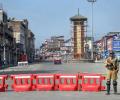
A change in the name of the Al Qaeda in the Indian Subcontinent (AQIS) magazine 'suggests a refocusing' of the terror group from Afghanistan to Kashmir, a United Nations report has said.
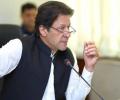
Pakistan, the report said, has played an active, and by many accounts, a negative role in Afghan affairs for decades.

Unlike football, which offends the sensibilities of some very conservative Muslims because it is normally played in shorts, cricket is played in long sleeves and trousers, in line with traditional dress codes. It also bears some resemblance to traditional Afghan children's games involving throwing and using sticks to hit smaller sticks or balls.

'There is far more goodwill towards India from across the board in Afghanistan'

'The danger today is that out of sheer fatigue and exasperation, the US might cut loose and exit from Afghanistan leaving it to the region to cope with the debris, which it is ill-equipped to handle,' says Ambassador M K Bhadrakumar.

The alacrity with which regional States responded to Delhi's invite signals that expectations are high regarding an Indian role in the efforts to stabilise the situation in Afghanistan, observes Ambassador M K Bhadrakumar.
